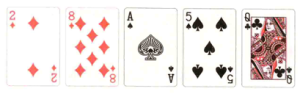
Texas Hold’em originated in the early 20th century in Robstown, Texas. It is said that locals invented this poker variant, which allowed multiple players to participate simultaneously, as a way to pass the time. In 1925, Texas Hold’em first reached Dallas, Texas, and later spread to Las Vegas, where it truly began to flourish and gain widespread popularity.

Texas Hold’em is divided into three main betting structures based on wagering limits: Limit, No-Limit, and Pot-Limit. Among them, No-Limit Texas Hold’em has the simplest rules and is overwhelmingly favored by players due to its extreme action and potential. The World Series of Poker (WSOP), which primarily features No-Limit Texas Hold’em events, has been held annually in various casinos in Las Vegas since the 1970s. The most prestigious of these is the Main Event, which offers the highest prize pool, attracts the largest number of participants, and receives the most attention. It is broadcast live on sports channels across North America, allowing more and more people to become familiar with Texas Hold’em. This marked the beginning of its large-scale popularity. With television and media coverage of various international tournaments, especially the rise of internet promotion and online platforms, if someone in the United States says they are “playing poker,” they are almost certainly referring to Texas Hold’em.
Texas Hold’em is known for being easy to learn but difficult to master, attracting and uniting a massive number of loyal players worldwide. It is favored by card game enthusiasts in many countries and has become a classic poker game that dominates Europe and America. It is often called the poker variant where you can “learn it in a day, but spend a lifetime mastering it.”
However, the true explosive growth of Texas Hold’em occurred in 2003. A young accountant named Chris Moneymaker qualified for the WSOP Main Event through an online poker satellite tournament. He then went on to defeat poker legends such as Johnny Chan, Phil Ivey, and Dan Harrington, eventually winning heads-up against Sammy Farha. His hand held up until the end, earning him a $2.5 million first-place prize and the iconic WSOP gold bracelet. In the three years following Chris Moneymaker’s victory, approximately 2 million people joined online Texas Hold’em games. From that point onward, Texas Hold’em became indisputably the most popular form of poker in the world.
The game is played with 2 to 10 players using a standard 52-card deck (no jokers). Each player receives 2 hole cards, and over the course of the hand, 5 community cards are dealt face-up on the board. Players must make the best possible 5-card hand using any combination of their hole cards and the community cards. The player with the highest-ranking hand wins.
A hand of Texas Hold’em consists of four betting rounds:
After each player receives their 2 hole cards → first betting round (pre-flop)
After the flop (3 community cards) is dealt → second betting round
After the turn (4th community card) is dealt → third betting round
After the river (5th and final community card) is dealt → fourth betting round
After the final betting round, if more than one player remains, there is a showdown, and the player with the best 5-card hand wins the pot.
Hand rankings (from highest to lowest):
Royal Flush > Straight Flush > Four of a Kind (Quads) > Full House > Flush > Straight > Three of a Kind (Trips / Set) > Two Pair > One Pair > High Card
Detailed explanations of each hand type:
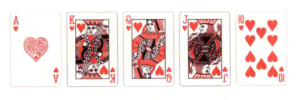
Royal Flush: The highest possible hand — A, K, Q, J, 10, all of the same suit. (Note: the card 10 is commonly written as T in poker notation.)
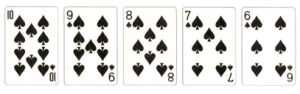
Straight Flush: Five consecutive cards of the same suit.
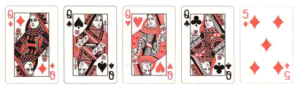
Four of a Kind (Quads): Four cards of the same rank, plus one unrelated card (kicker).
Full House: Three cards of one rank plus two cards of another rank (also called a “boat”).
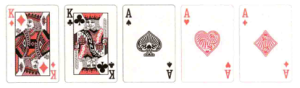
Flush: Five cards of the same suit, not in sequence.
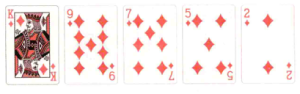
Straight: Five consecutive cards of different suits.
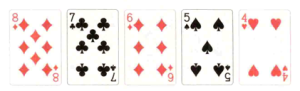
Three of a Kind: Three cards of the same rank, plus two unrelated cards.
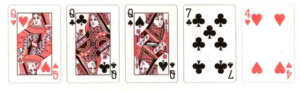
Two Pair: Two different pairs, plus one unrelated card.
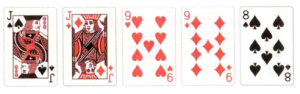
One Pair: One pair, plus three unrelated cards.
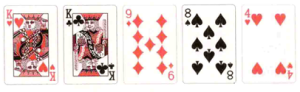
High Card: A hand consisting of single cards of different suits that are not in sequence.